Self-Cleaning Filters: How Do They Work — and When Should You Use One?
Filtration systems that stop production every time the screen clogs are expensive to run — in labor, in downtime, and in consumables. Self-cleaning filters solve this by cleaning themselves online, without interrupting flow. This guide explains how they work, what separates a well-built unit from a basic one, and what to send us for an accurate quotation.
1. What Is a Self-Cleaning Filter?
A self-cleaning filter is an inline, pressure-driven filtration device. It consists of a housing, a wedge wire or perforated screen, a cleaning assembly, a drive motor, a drain valve, a differential pressure transmitter, and an electrical control system.
Liquid enters the housing through the inlet. Contaminants are retained on the inner surface of the screen, and clean media passes through to the outlet. As solids accumulate, the differential pressure across the screen rises. When it reaches a preset value — or when the set cleaning interval is reached — the unit automatically activates the cleaning mechanism, which scrapes or suction-removes the debris from the screen surface and opens the drain valve to discharge the waste. Filtration continues throughout the cleaning cycle; there is no shutdown and no interruption of flow.
Screens. The standard screen is stainless steel wedge wire, with filtration precision from 20 to 3000 μm. Wedge wire suits fine-particle retention and is fully backwashable. Perforated screens are used for coarse debris retention and as cartridge support, with openings of 0.5 mm and above — note that hole size cannot be smaller than plate thickness, so perforated screens are not a micron-level solution.
Housings. Carbon steel with anti-corrosion coating, 304/316L stainless steel, duplex SS2205/SS2507, or Hastelloy C276. Nominal pressure PN1.0–1.6 MPa, flanged connections.
Control. Differential-pressure trigger, timed trigger, manual mode, and PLC remote signal output.
Typical applications: circulating water systems, reclaimed water reuse, raw water pre-treatment, cooling water, heat exchanger protection, RO pre-filtration, municipal water supply, and chemical process water — removing sand, rust, suspended solids, and algae to protect downstream pumps, heat exchangers, and membrane elements. Well suited to 24/7 continuous duty. Flow rate, pressure rating, and corrosion class can be customized.
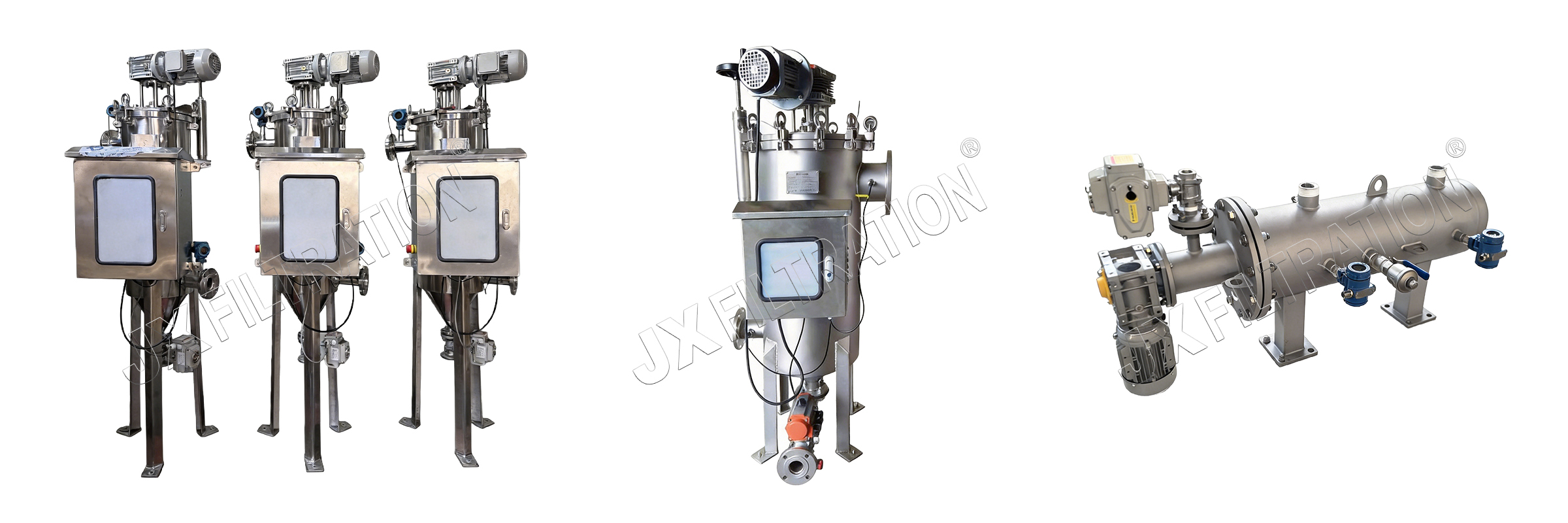
Learn more about our products: Self-Cleaning Filter product page
2. JX Filtration Self-Cleaning Filters — Key Advantages
JX Filtration self-cleaning filters deliver continuous, automated operation without process interruption — significantly reducing labor and consumable costs compared with traditional solutions. Filtration precision ranges from 20 μm standard elements down to 5 μm with specialized cartridges. Material options include carbon steel, SS304, SS316, duplex steels 2205 and 2507, and Hastelloy C276, covering a wide range of fluids and operating conditions. Units are available with electric or pneumatic actuation, support multiple cleaning modes (brush, suction, scraper, and backwash), and are controlled via a Siemens PLC with a 7-inch touch screen. Vertical or horizontal configurations are available, jacketed versions can be supplied, and connection sizes, flange standards, and power supply are fully customizable.
1) Online cleaning, continuous flow. The entire cleaning and blowdown cycle runs without shutting down the unit or interrupting media flow — ideal for continuous production processes, and eliminating downtime losses.
2) Fully automatic, minimal manual intervention. Cleaning is triggered by differential pressure, by time, or both. No manual screen removal or washing is required, and a digital output signal can be sent to a host PLC for unattended operation.
3) Strong screen, long service life. The stainless steel wedge wire screen is wear-resistant and pressure-resistant, resists damage, and can be cleaned and regenerated repeatedly — unlike filter bags and cartridges, which are single-use consumables. This substantially reduces replacement costs.
4) Low blowdown water consumption. A single cleaning cycle takes 30–120 seconds, and blowdown water accounts for only 1–3% of total flow. Actual cleaning duration and frequency should be set according to site conditions.
5) High dirt-holding capacity for high-solids duties. Suited to high-flow systems with continuous solids generation — particularly circulating water side-stream filtration and raw water pre-treatment — avoiding frequent bag or cartridge changes.
6) Compact, simple installation. Inline straight-through piping; the vertical design takes up little floor space and connects directly into the pipeline, with no civil filter basin required. Horizontal and vertical mounting options are both supported.
7) Flexible materials for different media. Housing options include coated carbon steel, 304, 316L, SS2205, SS2507, and Hastelloy C276; screens are selected to suit the duty. Suitable for clean water and mildly corrosive media, with explosion-proof controls and high-temperature versions available on request.
8) Complete protection functions. Motor overload protection with fault alarm, real-time differential pressure monitoring, and a manual test mode for on-site commissioning and maintenance.
3. Proven in the Field
- Malaysian stevia production — tailored self-cleaning filtration solutions for a stevia processing line.
https://product.jxfiltration.com/blog/automatic-self-cleaning-filter-malaysia-20260701-nxsdbf/ - High-viscosity water-based paint, Indonesia — a self-cleaning filtration solution for a demanding coating duty.
https://product.jxfiltration.com/blog/automatic-self-cleaning-filter-indonesia-20260628-oaeiht/ - Paint, coating and ink manufacturing in Vietnam — reliable pre-filtration solutions protecting downstream processes.
https://product.jxfiltration.com/blog/automatic-self-cleaning-filter-vietnam-20260821-vdqghw/
4. Frequently Asked Questions
1) What do I need to send for a quotation?
Please share: ① flow rate to be handled; ② media details — name, temperature, and pH; ③ inlet suspended solids, impurities, or solids content; ④ filtration precision required; ⑤ system working pressure; ⑥ pipeline diameter; ⑦ housing material preference; ⑧ control requirements — standard or explosion-proof, and whether remote signals are needed; ⑨ installation space constraints. Not sure about some of these? Send what you have — we can help with selection and issue a drawing for confirmation.
2) Self-cleaning filter or bag filter — which should I choose?
Self-cleaning filters suit high-flow, continuous operation where frequent consumable changes are undesirable. Their practical precision floor is generally around 20 μm and above, the screen is reusable, and they are best suited to coarse-to-medium pre-treatment. Bag filters reach finer precision — down to 0.5 μm — but rely on single-use bags, making them better suited to small-to-medium flows and fine filtration. Many projects combine the two: self-cleaning filtration as pre-treatment, with bag or cartridge filters for downstream polishing.
3) How do I choose the housing material?
For general cooling water and clean water, coated carbon steel or SS304 is sufficient. For municipal water and mildly corrosive duties, choose SS304 or SS316. For chemical corrosive media and seawater, choose SS2205 or SS2507 duplex stainless steel. For highly aggressive media, Hastelloy C276 is available.
4) Can it be used for wastewater or oily media?
It can handle general wastewater. It is not suitable for high-viscosity media, heavy floating oil, or viscous flocculent sludge — sticky deposits adhere to the screen and cannot be fully removed by scraping, causing cleaning to fail. For viscous media, bag filtration is the better choice.
5) Does the water supply stop during cleaning?
No. Under normal online cleaning, the outlet flow continues — the unit filters and discharges blowdown simultaneously, with no need to switch to a bypass line. Shutdown and isolation of upstream/downstream valves are only required for inspection and cover removal.
6) What working pressure is available? Can you supply high-pressure versions?
Standard units are rated PN1.0/1.6 MPa. Higher pressures can be designed as non-standard pressure vessels; please provide the design pressure.
7) What differential pressure should trigger cleaning?
A typical site setting is 0.01–0.1 MPa. For dirtier water the setpoint can be raised, and for cleaner water it can be lowered.
8) What is the lead time?
2–4 weekss.
9) What payment methods do you accept?
T/T, PayPal, and Letter of Credit (L/C).
10) How fast do you respond?
Pre-sales — same-day reply after receiving your inquiry, with drawings or a quotation within 1–2 days. After-sales — response within 2 hours, with a solution provided within 24 hours.
11) Is there a warranty?
Yes — a 1-year warranty covering non-human-caused quality issues, with free replacement products provided.
5. Let's Select Your Self-Cleaning Filter
Tell us your flow rate, media, solids content, filtration precision, working pressure, pipeline diameter, and control requirements — and we'll come back with a drawing and quotation, usually within 1–2 days.
Learn more about our products: Self-Cleaning Filter product page