Cartridge Filter Housings: How to Choose the Right Precision Filter
When a filtration system needs to deliver consistently clean liquid — not just “cleaner than before” — cartridge filter housings are usually the answer. They are the standard choice for RO pre-filtration, pharmaceutical water, food and beverage polishing, and fine chemical processing. But with so many cartridge types, materials, and housing options, specifying the right unit takes some thought. This guide covers how cartridge housings work, what to look for, and what to send us for an accurate quotation.
1. What Is a Cartridge Filter Housing?
A cartridge filter housing — also called a precision or guard filter — is a liquid filtration device built around a housing, a filter cartridge, O-ring seals, a quick-opening mechanism, and pipeline connections.
Liquid enters the housing and passes from the outside of the cartridge inward. Particles, colloids, and suspended solids are retained by the cartridge media, and clean liquid collects in the cartridge core and exits through the outlet. Cartridge condition is monitored by differential pressure; when the pressure drop exceeds the limit, the cartridge is replaced. The housing is designed for high-precision solid-liquid separation.
Key specifications:
- Housing materials: SS304, SS316L, carbon steel, or duplex SS2205/SS2507.
- Configurations: single-cartridge or multi-cartridge, with standard cartridge lengths of 10, 20, 30, 40, and 60 inches. Custom lengths and flow ratings are available.
- Filtration precision: 0.1 μm to 200 μm.
- Cartridge options: PP melt-blown, pleated membrane, wound, and stainless steel sintered cartridges, among others.
- Design pressure: 0.6–1.0 MPa as standard, with custom pressure ratings available.
- Media viscosity: suitable for 1–1200 cp.
- Sanitary construction: available, with parallel multi-unit arrangements for capacity expansion.
Typical applications: RO and pure-water pre-filtration (guard filtration), fine chemicals, food and beverage, pharmaceuticals, electroplating, coatings, oilfield produced-water reinjection, and precision filtration of circulating water — protecting downstream membranes, pumps, and heat exchangers.
The housing is best suited to media with an impurity content below 0.1%; actual suitability should be assessed together with viscosity and density.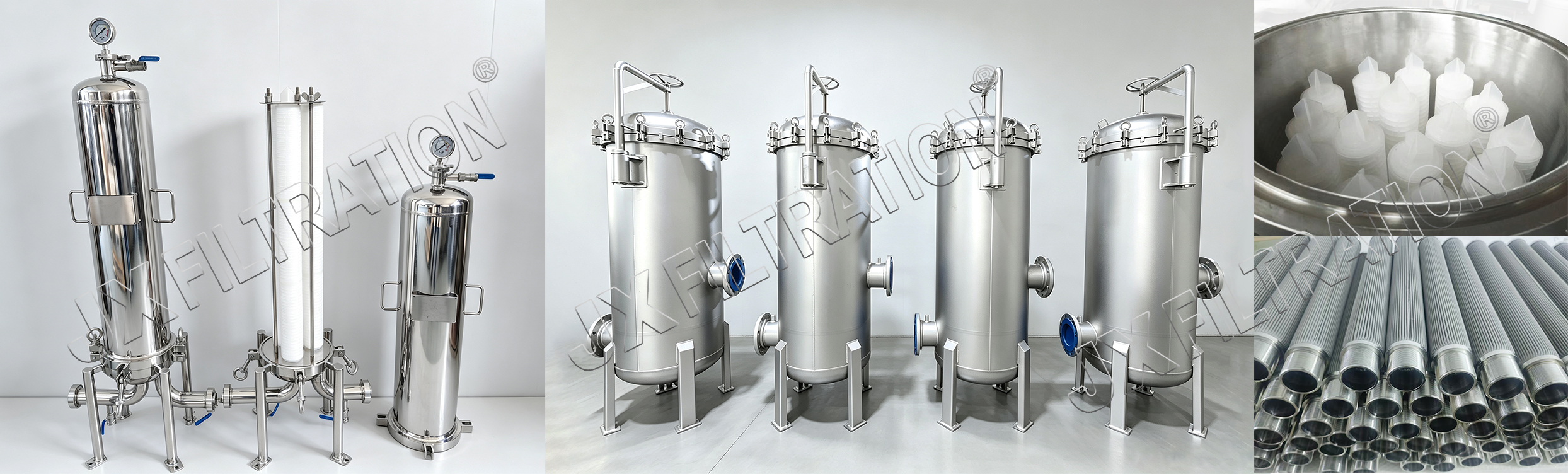
Learn more about our products: Cartridge Filter product page
2. JX Filtration Cartridge Filter Housings — Key Advantages
JX Filtration cartridge filter housings are built around filtration precision down to 0.1 μm. They accept PP, PES, and PTFE pleated cartridges as well as high-flow, melt-blown, and wound cartridges (with DI/DOE end connections and lengths from 5 to 40 inches), covering duties from precision filtration to sterilizing adsorption. The housing body is welded with a fish-scale process to eliminate leakage, and materials include SS304/316, titanium, and carbon steel. Connections and structures are fully customizable, and both food-grade sanitary models and ASME U-stamp industrial models are available.
1) High, stable filtration precision. Precision down to 0.1 μm retains fine particles, colloids, and some microorganisms, delivering consistently clean output — the first choice for RO and ultrafiltration guard filtration.
2) Wide cartridge range, strong media compatibility. The housing accepts PP, PES, PTFE, nylon, and metal sintered cartridges, suiting acids, bases, organic solvents (PP is not suitable for solvents), and high-temperature liquids, for both general industrial and sanitary duties.
- Pleated membrane cartridges (PES/PTFE/nylon): 0.1, 0.22, 0.45, 0.8, and 1 μm — absolute ratings for sterilization, pure water, and pharmaceutical use.
- PP pleated cartridges: 0.1–50 μm; 5 μm and 1 μm are common for RO pre-treatment.
- PP melt-blown cartridges (the most widely used guard cartridges): 1, 3, 5, 10, 20, 30, and 50 μm — nominal ratings.
- Wound cartridges: 1–100 μm, suited to duties with minor sand and colloids.
- Stainless steel sintered / metal pleated cartridges: 0.1–200 μm, high-temperature resistant, cleanable, and reusable.
- High-flow cartridges: 1–70 μm, with high flow per cartridge to reduce cartridge count.
3) Compact, space-saving design. The vertical housing and modular single-to-multi cartridge design take up far less floor space than a bag filter of the same flow. Units can be paralleled on site for capacity expansion.
4) Quick-opening for easy maintenance. The quick-opening swing-bolt or clamp cover needs no special tools, making cartridge change-out fast. The housing includes vent and drain ports for easy emptying during shutdown.
5) Excellent sealing performance. The recessed cover design and reliable O-ring seal reduce leakage risk and prevent filtration bypass. Sanitary models are free of dead corners.
6) Choice of materials and full customization. Housing material, surface finish (including mirror polishing for sanitary duty), connection type, inlet/outlet size, and support legs can all be customized.
7) Sanitary option available. Polished sanitary housings with no retention dead corners meet the clean production requirements of food and pharmaceutical manufacturing.
3. Proven in the Field
Irish construction industry client — backwash and cartridge filter solutions for a construction water treatment application.
https://product.jxfiltration.com/blog/automatic-backwash-filter-cartridge-ireland-20260907-bmgdko/
4. Frequently Asked Questions
1) What do I need to send for a quotation?
Please share: ① flow rate to be handled; ② media details — name, temperature, and pH; ③ inlet suspended solids, impurities, or solids content (below 5%); ④ filtration precision required; ⑤ system working pressure; ⑥ pipeline diameter; ⑦ housing material preference; ⑧ installation space constraints. Not sure about some of these? Send what you have — we can help with selection and issue a drawing for confirmation.
2) Cartridge filter or bag filter — which should I choose?
Bag filters offer high dirt-holding capacity and high flow, suit liquids with higher solids content, cover a precision range of 0.5–200 μm, and have low consumable costs. Cartridge filters suit high-precision polishing but hold less dirt, so bags would need frequent replacement when solids are high. For high-solids, high-flow pre-treatment, choose bag filters; for downstream high-precision filtration, choose cartridge filters. The two are often used in series: bag filtration as pre-treatment, cartridge filtration for final polishing.
3) How do I choose the housing material?
For general cooling water and clean water, coated carbon steel or SS304 is sufficient. For municipal water and mildly corrosive duties, choose SS304 or SS316. For chemical corrosive media and seawater, choose SS2205 or SS2507 duplex stainless steel.
4) Can it be used for wastewater or oily media?
It can handle general wastewater. Oily media are also possible, but standard PP cartridges should not be used (they tend to swell) — choose oil-resistant cartridges such as PTFE. Please provide the oil type, oil concentration, and temperature so we can assess material compatibility.
5) What working pressure is available? Can you supply high-pressure versions?
Standard units are rated PN1.0/1.6 MPa, and PN1.0 MPa covers most applications. Higher pressures can be designed as non-standard pressure vessels; please provide the design pressure.
6) Can you supply sanitary housings for food and pharmaceutical use?
Yes. We offer 316L bodies with mirror-polished interior and exterior, clamp-type quick-opening connections, food-grade gaskets, and sanitary cartridges to meet food and pharmaceutical requirements.
7) When should the cartridge be replaced?
Base replacement on the differential pressure across the housing. A new cartridge typically starts at 0.02–0.05 MPa; replacement is recommended when the differential pressure rises to 0.10–0.15 MPa. Replacement intervals can also be set according to water quality and operating hours.
8) What is the maximum operating temperature?
Temperature limits depend on the cartridge and O-ring material: PP up to 60 °C; PES up to 80 °C; PTFE and stainless steel sintered cartridges withstand higher temperatures, up to 200 °C. The stainless steel housing itself has ample temperature margin.
9) What is the lead time?
Standard models ship in 1–2 weeks; large custom orders within 30 days.
10) What payment methods do you accept?
T/T, PayPal, and Letter of Credit (L/C).
11) How fast do you respond?
Pre-sales — same-day reply after receiving your inquiry, with drawings or a quotation within 1–2 days. After-sales — response within 2 hours, with a solution provided within 24 hours.
12) Is there a warranty?
Yes — a 1-year warranty covering non-human-caused quality issues, with free replacement products provided.
5. Let's Select Your Cartridge Filter Housing
Tell us your flow rate, media, solids content, filtration precision, working pressure, pipeline diameter, and installation requirements — and we'll come back with a drawing and quotation, usually within 1–2 days.
Learn more about our products: Cartridge Filter product page