Customized Sludge Dewatering Solution for a U.S. Client
Project Overview
A U.S.-based client approached us with a clear and straightforward requirement: they needed a sludge dewatering press to treat septic tank sludge at a processing capacity of approximately 8,000 gallons per hour, with a solids content of 2%. The equipment was required to be constructed entirely from 304 stainless steel to ensure corrosion resistance and long-term durability in their operating environment.
After carefully evaluating the client's needs, we proposed a solution using two JXDL402 sludge dewatering presses operating in parallel. This configuration not only achieves the target throughput but also offers redundancy—if one unit requires maintenance or servicing, the other can continue operating, minimizing downtime and ensuring continuous plant operation.
Recommended Spare Parts and Accessories
To support reliable long-term operation, we recommended that the client stock the following spare parts and consumables:
| Item | Recommended Quantity | Remarks |
| ---- | -------------------- | ------- |
| Moving rings + fixed rings | 30 sets | One set consists of one moving ring and one fixed ring; used for routine wear replacement |
| Main unit bearings | 5 pcs | Critical for the screw shaft assembly |
| Mixer bearings | 8 pcs | For the agitator/mixing assembly |
| Spray nozzles | 10 pcs | For periodic cleaning of the filter media |
| Bolts | Assorted set | A selection of key fasteners used on the equipment |
| Back pressure plates | 3 pcs | For adjusting and controlling discharge pressure |
Electrical Control and Interface – Client's Requirement
During the detailed engineering and drawing phase, we reached out to the client to confirm whether any auxiliary equipment—such as feed pumps or conveyors—should be integrated into our control panel for centralized control.
The client's response was very specific:
"We require a relay output signal to shut off the feed pump when the dewatering unit stops. No other auxiliary equipment needs to be controlled through the control panel."
In accordance with this instruction, we designed the control system to include a dedicated relay output that triggers a shutdown signal to the feed pump immediately upon equipment stoppage. This ensures process safety by preventing sludge overflow or spillage. All other auxiliary devices remain independently controlled by the client's existing systems, as requested.
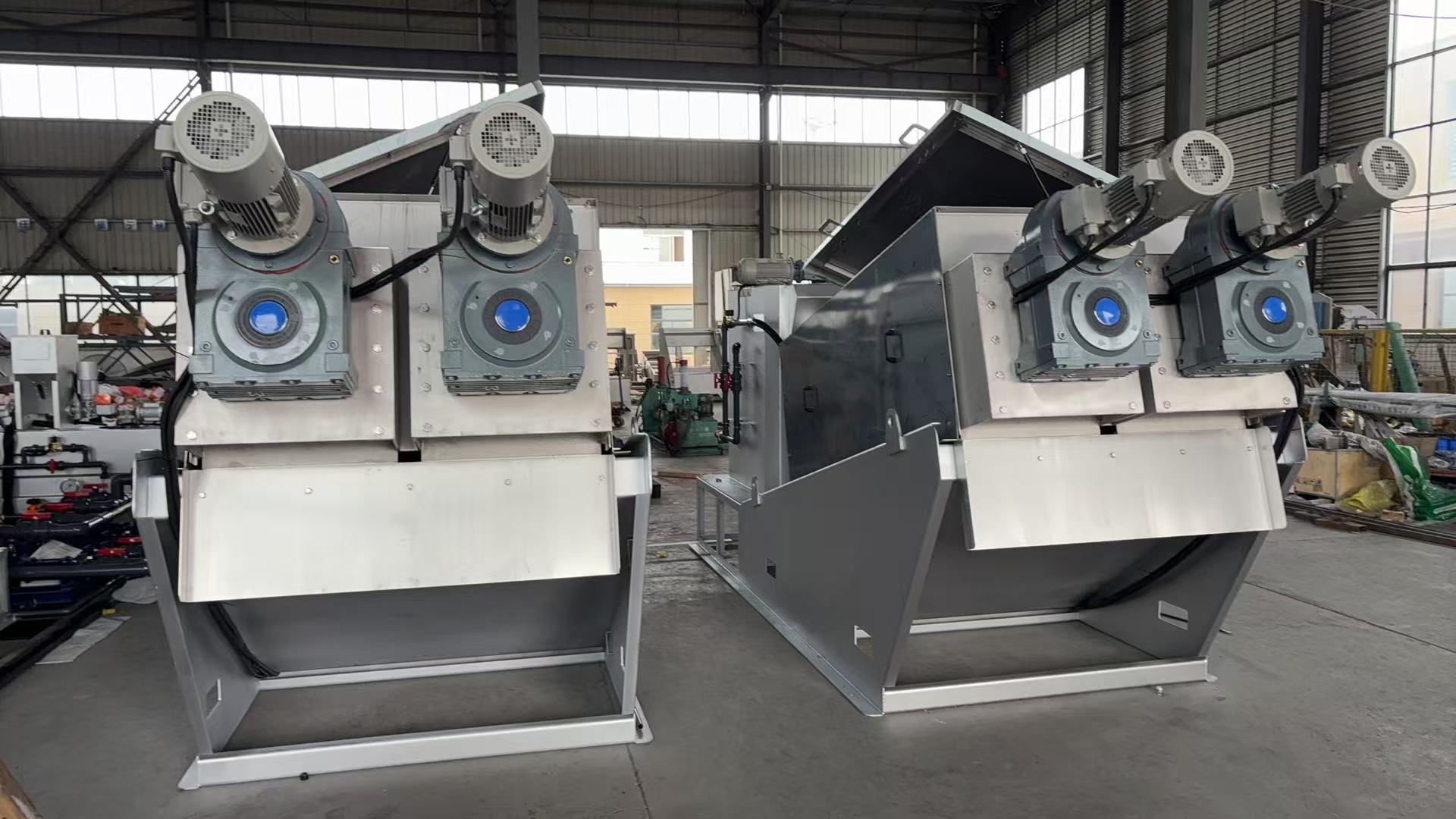 — Overall view of the two JXDL402 units —
Equipment Delivery and Current Status
We are pleased to confirm that both JXDL402 units have been successfully manufactured, thoroughly tested, and delivered to the client's site.
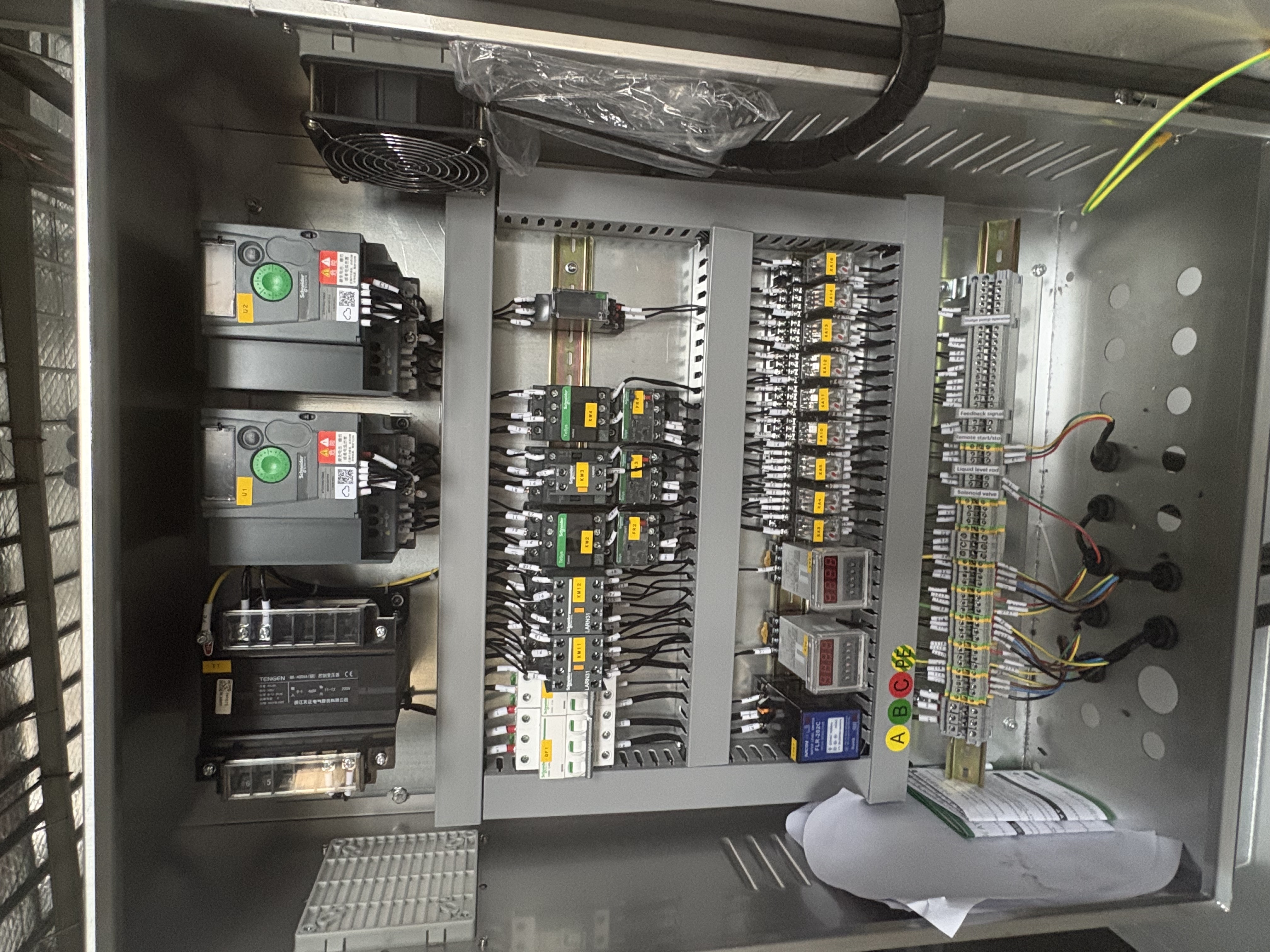 — View of the control panel, showing the relay output terminals and main interface —
— Video showing the equipment —
Key Features of the Sludge Dewatering Press
The dewatering press (also commonly referred to as a screw press) offers a number of distinct advantages that made it the ideal choice for this application. A brief introduction to its key features is provided below:
- Low Energy Consumption – The screw shaft operates at an extremely low rotational speed, resulting in significantly reduced power consumption compared to conventional dewatering technologies such as centrifuges or belt filter presses.
- Self-Cleaning Design – The unique interaction between the moving and fixed rings creates a slight relative motion during operation, which continuously cleans the filter gaps. This effectively prevents clogging, even when processing oily, greasy, or fibrous sludge commonly found in septic tank applications.
- Compact and Space-Saving – The equipment has a small footprint and a modular design, making it easy to install in facilities with limited space.
- Minimal Operator Intervention – The system operates fully automatically and requires little manual oversight. The relay output feature provides seamless integration with upstream feed systems, ensuring safe and coordinated operation.
These inherent features, combined with the parallel dual-unit configuration and the thoughtfully selected spare parts package, provide the client with a robust, reliable, and cost-effective dewatering solution.