Bag Filter Housings: How to Choose the Right System for Your Application
Bag filters are one of the most practical ways to remove suspended solids from liquids — simple in principle, but surprisingly varied in execution. Single-bag or multi-bag? Stainless steel or carbon steel? What bag size and material? This guide walks through how bag filter housings work, what makes a well-built housing, and what to send us for an accurate quotation.
1. What Is a Bag Filter Housing?
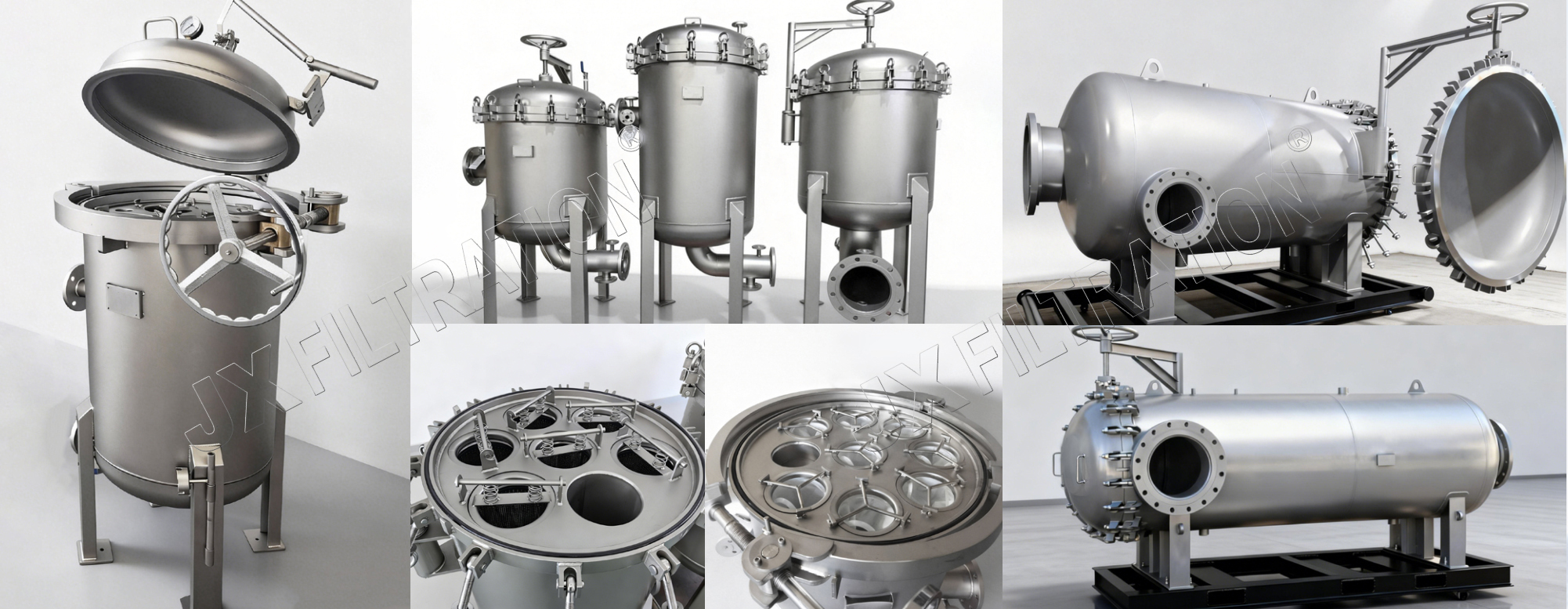
A bag filter housing is a pressure-driven solid-liquid separation device. It consists of a housing body, filter basket, filter bag, cover, quick-opening mechanism, sealing components, inlet and outlet connections, and a pressure gauge port.
Liquid enters through the inlet, passes through the filter bag, which captures suspended solid particles and colloidal impurities, and exits through the outlet as filtrate. The captured impurities stay inside the bag, and maintenance is as simple as replacing the bag.
Housings are available in single-bag and multi-bag configurations. Body materials include 304/316L stainless steel, carbon steel with rubber or PTFE/PP lining, and more. Typical industries include chemical processing, coatings and inks, water treatment, electroplating, food and beverage, oil and gas, papermaking, and pharmaceuticals — serving duties such as raw material pre-treatment, circulating water purification, final polishing, and guard filtration.
Pressure rating, connection type, polished or sandblasted finish, quick-opening design, heat tracing, and drain/vent ports can all be customized.
Learn more about our products: Bag Filter Housing product page
2. JX Filtration Bag Filter Housing — Key Advantages
JX Filtration bag filter housings combine leak-tight construction, high dirt-holding capacity, and fast maintenance in a compact footprint — and they are built to be customized. Housings range from single-bag to 48-bag configurations, in SS304/316L, titanium, carbon steel, or PP, and are available in vertical or horizontal designs to suit your site layout. The body is welded with a fish-scale process for reliable sealing, and connections, fittings, and cover structures can all be tailored to your project. Both food-grade sanitary models and ASME U-stamp industrial models are available, along with multi-unit skid layouts and multi-stage bag filtration systems.
1) Leak-tight welded body. The housing body is welded with a fish-scale welding process, ensuring reliable sealing and eliminating leakage.
2) High flow and high dirt-holding capacity. The filter bag offers a large effective filtration area. Compared with cartridge filters of the same volume, bag filters deliver higher flow and greater dirt-holding capacity — well suited to media with higher solids content, and extending the consumable replacement cycle.
3) Fast, simple maintenance. The quick-opening structure requires no special tools. Bag replacement is straightforward, and in some applications the switch can be made without a prolonged shutdown. The housing itself needs no frequent cleaning — replacing the bag is enough.
4) Reliable sealing, reduced bypass risk. A bag collar pressure ring plus an elastic sealing gasket, combined with a precision-machined support basket, reduce bag bypass and leakage — protecting the actual filtration precision.
5) Low pressure drop, low energy consumption. Smooth flow passages keep the initial pressure differential low under normal conditions, reducing pump load and saving energy over long-term operation. The housing is built to handle standard system working pressures.
6) Wide media compatibility. Bag materials include PP, PE, and PTFE needle-felt bags as well as nylon (NO) monofilament bags, covering weak acids, weak bases, organic solvents, high temperatures, and high-viscosity liquids. As a rule of thumb: for polar liquids such as acids, bases, and salts, choose PP (polypropylene); for less polar liquids such as solvents, choose PE (polyester) or NO (nylon).
7) Compact footprint. The vertical cylindrical design takes up little floor space, making piping modifications and skid integration easier. With no complex moving parts, the overall failure rate is low.
8) Flexible customization. Body material, number of bags, pressure rating, connection specifications, surface treatment, drain/vent ports, heat tracing, lifting lugs, and more can all be specified to meet non-standard project requirements.
3. Proven in the Field
- Indonesia's first refined crystal sugar factory — 3-bag and 8-bag filter housings for a new sugar refining line.
https://product.jxfiltration.com/blog/3-bag-filter-housing-8-bag-filter-indonesia-20260920-nscfls/ - A valued partner in Saudi Arabia — a custom 25-bag filter housing solution.
https://product.jxfiltration.com/blog/25-bag-filter-housing-saudi-arabia-20260709-viiuol/ - High-solids water-based coatings in Canada — a single-bag filter housing for paint filtration.
https://product.jxfiltration.com/blog/single-bag-filter-housing-canada-20260630-pikykv/
4. Frequently Asked Questions
1) What do I need to send for a quotation?
To select and quote the right housing, please share: ① flow rate to be handled; ② media details — name, pH, temperature, and viscosity; ③ inlet solids — suspended solids or solids content; ④ filtration precision required; ⑤ system working pressure; ⑥ connection requirements; ⑦ body material preference; ⑧ special site requirements — explosion-proof, heat tracing, food-grade sanitary, etc. Not sure about some of these? Send what you have — we can help with selection and issue a drawing for confirmation.
2) Bag filter or cartridge filter — which should I choose?
Bag filters offer high dirt-holding capacity and high flow, suit liquids with higher solids content, cover a precision range of 0.5–200 μm, and have low consumable costs. Cartridge filters suit high-precision polishing but hold less dirt, so cartridges need frequent replacement when solids are high. For high-solids, high-flow pre-treatment, choose bag filters; for downstream high-precision polishing, choose cartridge filters. The two can also be used in series.
3) What bag sizes are available?
Precision ranges: PP and PE bags 0.5–200 μm; NO nylon bags 25–1200 μm — suited to high-flow, medium-to-high solids duties. The industry standard is Size 1 and Size 2 (Size 2 is the most common and is the default for single- and multi-bag housings). Sizes 3 and 4 are small bags for low flow; Size 5 is a medium bag.
- Size 1: collar diameter × length Φ180 × 430 mm; effective filtration area 0.25 m²; reference clean-water flow per bag 20 m³/h.
- Size 2: collar diameter × length Φ180 × 810 mm; effective filtration area 0.50 m²; reference clean-water flow per bag 40 m³/h.
- Size 3: collar diameter × length Φ102 × 230 mm; effective filtration area 0.09 m²; reference clean-water flow per bag 6 m³/h.
- Size 4: collar diameter × length Φ102 × 380 mm; effective filtration area 0.15 m²; reference clean-water flow per bag 12 m³/h.
- Size 5: collar diameter × length Φ150 × 520 mm; effective filtration area 0.30 m²; reference clean-water flow per bag 20 m³/h.
4) How do I choose the bag material?
Size 2 is the default. For polar liquids such as acids, bases, and salts, choose PP (polypropylene); for less polar liquids such as solvents, choose PE (polyester) or NO (nylon); for high-temperature or highly corrosive duties, PTFE needle-felt bags are available.
5) How often should the bag be replaced?
Base replacement on pressure differential rather than time — time-based estimates are unreliable. Replace the bag when the differential pressure reaches the set value or when flow drops noticeably. The actual cycle depends on the solids content of the media: the more impurities, the more frequent the replacement.
6) Can you supply sanitary housings for food and pharmaceutical use?
Yes. We offer 316L bodies with mirror-polished interior and exterior, clamp-type quick-opening connections, food-grade gaskets, and sanitary filter bags to meet food and pharmaceutical requirements.
7) Can the housing be ASME U-stamped?
Yes. JX can design and manufacture to ASME standards and provide the U stamp.
8) Can process connections and flange standards be customized?
Absolutely. Connection sizes and flange standards (such as JIS, DIN, and ANSI) can be customized to project requirements, and threaded or quick-connect designs are also supported.
9) What are the advantages of a duplex bag filter?
A duplex unit with "one duty, one standby" allows online switching, so production continues while one side is being re-bagged. It can also run in "dual parallel" mode, with both housings working together to increase total system flow or handle larger batches. This gives operators the flexibility to switch between "standby protection" and "flow doubling" according to actual production needs — one unit, multiple uses.
10) What is the lead time?
Standard models ship in 1–2 weeks; large custom orders within 30 days.
11) What payment methods do you accept?
T/T, PayPal, and Letter of Credit (L/C).
12) How fast do you respond?
Pre-sales — same-day reply after receiving your inquiry, with drawings or a quotation within 1–2 days. After-sales — response within 2 hours, with a solution provided within 24 hours.
13) Is there a warranty?
Yes — a 1-year warranty covering non-human-caused quality issues, with free replacement products provided.
5. Let's Select Your Bag Filter Housing
Tell us your flow rate, media, solids content, filtration precision, working pressure, and connection requirements — and we'll come back with a drawing and quotation, usually within 1–2 days.
Learn more about our products: Bag Filter Housing product page