Wedge Wire Screens: Which Type Do You Need — and How Do You Specify It?
Wedge wire screens — also called Johnson screens — are among the most dependable filter elements in water treatment, desalination, and process industries. But specifying the right screen can be confusing: cylinder or panel? Which alloy? What slot size? This guide walks through the essentials and shows you exactly what to send us for an accurate quotation.
1. What Is a Wedge Wire Screen?
A wedge wire screen is a filtration element built from profiled wedge-shaped wires, resistance-welded to support rods. The V-shaped wire profile creates a continuous slot that lets fluid pass while blocking solid particles. Because the slot opens outward, particles are less likely to lodge in the screen — making it highly backwashable and long-lasting.
- Filtration range: 20 μm to 3000 μm.
- Typical industries: water treatment and environmental equipment, chemical processing, food and beverage, pharmaceuticals, mining, metallurgy, oil wells, seawater desalination, and aquaculture.
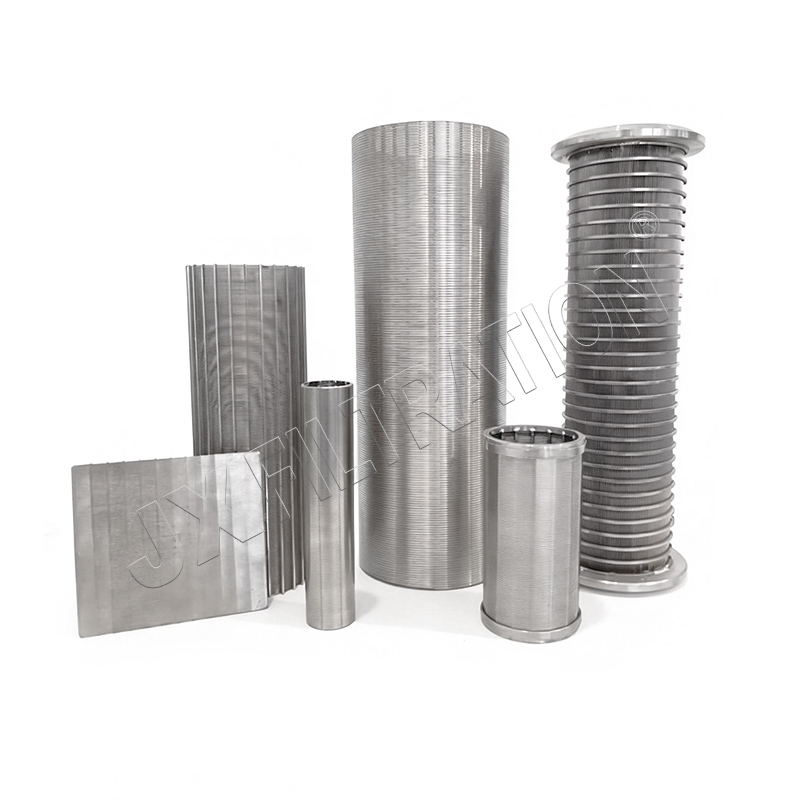 Learn more about our products: Wedge Wire Screen product page
2. Cylinder or Panel? Which Type Do You Need?
Wedge wire screens come in two main forms, and the right choice depends on how the screen is installed and what it needs to retain.
1) Wedge Wire Cylinder (Screen Tube)
A cylindrical screen with a continuous slot. Cylinders are used for sand control and fine-particle retention in flow-through systems.
Typical applications: well screens, self-cleaning filters, and seawater desalination.
2) Wedge Wire Panel (Screen Plate)
A flat, curved, or fan-shaped screen. Panels suit surface filtration and are available with frames, edging, and mounting holes as needed.
Typical applications: filter beds, vibrating screens, and coal washing.
3. What Sets JX Filtration Wedge Wire Screens Apart?
Not all wedge wire screens are built to the same standard. Here is what distinguishes ours:
1) Wide precision range with uniform slots. Our screens are resistance-welded on dedicated equipment, delivering high weld strength, uniform slot openings, and minimal manufacturing tolerance. Every screen is made to order.
2) Diverse, long-life materials. Standard options include SS304, SS316, and SS321. For seawater and high-salinity environments, SS2205 and SS2507 offer superior corrosion resistance. Titanium, Hastelloy C, 410, 430, and 904L are also available.
3) Mature structural engineering for high strength. For high-pressure environments, screens can be reinforced with welded support ribs, and the wall can be thickened where required — giving the screen high strength and strong pressure resistance with minimal deformation.
4) Strong customization for any application. Screens can be tailored to your site conditions, well depth, pressure, media characteristics, and sand control requirements — including shape (round, fan-shaped, flat, or curved), diameter, wall thickness, filtration precision, length, and connection type.
4. Proven in the Field
1) Seawater desalination, Morocco — Super Duplex 2507 screens with reinforcement ribs for corrosive desalination service.
https://product.jxfiltration.com/blog/wedge-wire-screen-morocco-20261015-paahre/
2) Aquaculture, Norway — SS316 drum screens and wedge wire screens meeting exceptionally strict technical standards.
https://product.jxfiltration.com/blog/wedge-wire-screen-norway-20261014-exjqix/
3) Nitrocellulose manufacturing, Indonesia — a repeat order that speaks to our quality and reliability.
https://product.jxfiltration.com/blog/wedge-wire-screen-indonesia-20261013-cccolu/
5. What to Send Us for a Quotation
The fastest way to get an accurate quote is to share these parameters:
1) For screen cylinders:
① material; ② slot size; ③ ID/OD, length, wall thickness; ④ end structure (closed ends, flange spec, connection type); ⑤ reinforcement ribs (yes/no and spec); ⑥ operating conditions (media, temperature, pressure, flow rate, seawater/high-salinity) and quantity.
2) For flat panels:
① material; ② slot size; ③ length × width, thickness; ④ support rod spec and reinforcement ribs; ⑤ edge and mounting details (edging, mounting holes/frame); ⑥ operating conditions and quantity.
3) For curved panels:
① material; ② slot size; ③ arc length/chord length, width, thickness, radius of curvature (or arc/angle); ④ support rod spec and reinforcement ribs; ⑤ edge and mounting details (edging, mounting holes/flange); ⑥ operating conditions and quantity.
Not sure about some of these? Send what you have — we can help with selection and issue a drawing for confirmation before production.
6. Frequently Asked Questions
1) Are wedge wire screens suitable for seawater?
Yes — specify SS2205 or SS2507 for high-salinity and seawater service. SS304 and SS316 suit standard duties.
2) What slot sizes are available?
From 20 μm to 3000 μm, customized to your retention requirements.
3) Can the screens be backwashed?
Yes. The V-shaped slot profile makes wedge wire screens highly backwashable.
4) Do you provide drawings or samples?
Yes. We issue drawings for confirmation before production and can produce samples (cost and lead time quoted separately).
5) What is the MOQ?
Standard specifications start from 1 piece; special materials or complex structures are evaluated case by case.
6) What is the lead time?
2–4 weeks. Standard cylinders ship in about 2 weeks; large custom orders take about 30 days.
7) What payment methods do you accept?
T/T, PayPal, and Letter of Credit (L/C).
8) Is there a warranty?
Yes — a 1-year warranty covers non-human-caused quality issues such as weld cracking, abnormal corrosion, or out-of-spec slot precision, with free replacement products provided. Wear parts and damage from improper use are not covered.
7. Let's Specify Your Screen
Tell us your application, media, particle size, flow rate, pressure, and connection requirements — and we'll come back with a drawing and quotation, usually the same day.